How It Evolved
Chronological histories of five world religions with every claim cited and confidence tagged
0 followers · 0 upvotes · DR 2 +1 (up) since last check
Interactive, evidence-based histories of Judaism, Christianity, Islam, Hinduism and Buddhism covering 9,000 years with 180 dated firsts, each linked to its
About How It Evolved
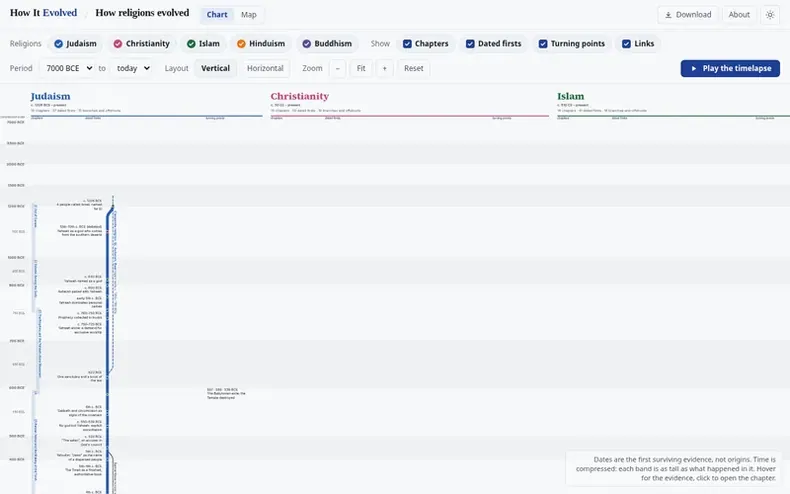
How It Evolved publishes chronological histories of five world religions—Judaism, Christianity, Islam, Hinduism and Buddhism—from their earliest traceable roots to the present. The site presents 180 dated historical firsts, each with primary source evidence, confidence ratings, and links to the academic scholarship behind them. Users can explore the religions individually or together on an interactive compressed-timeline chart that shows how traditions branched, merged and influenced each other over nine millennia. Every claim cites its specific source: verse, inscription, manuscript or peer-reviewed study. Confidence tags (Consensus, Majority, Contested, Speculative, Political) indicate how settled the evidence is for each dating. The site also offers downloadable posters, a data download in JSON format, and answers to frequently asked questions about each tradition.
- #interactive
- #primarysources
- #religioushistory
- #timelinechart
- #scholarlyresearch
- #chronological
- #citedclaims
In the toolkit
- Interactive timeline chart showing five religions over 9,000 years
- 180 dated historical firsts with primary source citations
- Confidence tags indicating evidence reliability (Consensus, Majority, Contested, Speculative, Political)
- 14-chapter series for each of five religions
- Questions answered with sources for each tradition
- Downloadable posters and data in JSON format
- Original language texts with transliteration and translation
- Cross-tradition linking showing religious influences and relationships
- Timelapse animation showing religious evolution year by year
Pricing
Pricing model: Free
Community Q&A
QWas Muhammad a real person?
From the profile Yes, as far as historians can tell. Almost every specialist, Muslim or not, accepts that Muhammad was a historical person who preached in Mecca, led a community in Medina from 622 and died around 632. The strongest evidence comes from outside the Muslim tradition: a Syriac Christian chronicle written about 640 records a battle in 634 fought by the Arabs of Muhammad, and an Armenian history of the 660s describes him as a merchant who taught the Arabs the God of Abraham.
QHow did Islam spread? Was it by the sword?
From the profile The empire was; the religion mostly was not. The Arab conquests of the 630s and 640s took Syria, Iraq, Egypt and Iran by war. But the conquered were not generally required to convert: Christians, Jews and Zoroastrians kept their religions as protected subjects who paid a poll tax, and Muslims were a minority in most conquered lands for one to three centuries or more. Conversion came through taxes, status, marriage, slavery and conviction.
QWhy did Sunni and Shia Muslims split?
From the profile It began as a political dispute over who should lead the community after Muhammad died in 632, and only slowly became a religious division. Those who held that leadership belonged to Muhammad's cousin and son-in-law ʿAlī and his descendants became the Shia; those who accepted the first four caliphs in turn became the Sunnis. Separate doctrines took shape between the eighth and tenth centuries.
QHow old is the oldest Qur'an?
From the profile The oldest surviving Qur'an leaves come from the seventh century, within a few decades of Muhammad's death in 632. No complete Qur'an survives from that time. Radiocarbon testing of their parchment shows leaves in Birmingham give 568–645, a leaf of the Ṣanʿāʾ palimpsest 578–669, a Berlin manuscript 606–652 and a Tübingen fragment 649–675. Their text is almost entirely the one printed today.
QWhat is Sharia, and where does it come from?
From the profile Sharia (sharīʿa, 'the path') is God's law as Muslims understand it. It developed from the Qur'an, reports of the Prophet's practice (hadith), reasoning by analogy (qiyas) and scholarly consensus (ijmaʿ). Four schools of law became dominant: Ḥanafī, Mālikī, Shāfiʿī and Ḥanbalī, which developed their own methods and doctrines between the eighth and tenth centuries.
How It Evolved has a free listing. The owner can unlock the full profile with a paid launch for $5:
- Founder story (locked)
- Milestones (locked)
- Demo video (locked)
- Dofollow website link (locked)
Similar companies
- Durham PeptidesCanada's trusted research peptide supplier with 99%+ purity and third-party testing